Local delivery
RNA-ONE can be administered directly to the target tissue, including through topical approaches.

Application Areas
Transient RNA delivery to activate skin repair where it is needed.
Skin regeneration depends on a tightly controlled sequence of biological signals.
Many regenerative proteins can stimulate repair, but their therapeutic use is often limited by short half-life, formulation constraints or the difficulty of maintaining sufficient local exposure.
RNA delivery offers another approach:
rather than repeatedly supplying the protein, transiently instruct skin cells to produce it locally.
RNA-ONE was developed to enable this type of localized biological programming.
Regenerative dermatology increasingly aims to influence the biological processes that control tissue repair rather than simply protect the wound environment.
RNA provides a way to transiently activate these pathways directly within the tissue.
The principle is simple:
deliver the instruction locally, allow skin cells to produce the biological factor, then let expression naturally decline.
This approach can generate a temporary regenerative signal without requiring permanent genetic modification.
For skin applications, where biological activity is often needed during a defined phase of repair, this temporal profile can be particularly relevant.
GEG Tech’s RNA-BEV platform for localized RNA delivery
RNA-ONE is GEG Tech’s proprietary RNA-BEV technology for transient delivery of functional RNA.
For dermatological applications, the platform combines three properties that are particularly relevant:
RNA-ONE can be administered directly to the target tissue, including through topical approaches.
The delivered RNA generates temporary biological activity adapted to the time scale of tissue repair.
The RNA payload can encode different regenerative or biological factors depending on the intended mechanism of action.
Together, these properties make RNA-ONE a platform for localized and programmable regenerative signaling.
GEG Tech has demonstrated that RNA-ONE can deliver functional mRNA through topical administration.
In reconstructed human epidermis, the vector penetrates the epidermal layers and drives transient protein expression throughout the epidermal compartment, while remaining largely confined to the epidermis.
Expression progressively decreases over the following days.
This provides an important proof of principle:
topically delivered RNA can transiently program skin tissue without requiring permanent genetic modification.
The approach creates a direct connection between vector administration and localized biological activity.
RNA-ONE has been evaluated using FGF7 mRNA, a regenerative factor involved in epithelial repair.
In cellular models, RNA-ONE-FGF7 increased keratinocyte migration in a scratch-wound assay.
The platform was subsequently evaluated in vivo in a diabetic wound-healing model.
RNA-ONE-mediated FGF7 delivery improved wound repair, with particularly clear differences in tissue regeneration and histological quality compared with the mRNA-LNP formulations evaluated in the study.
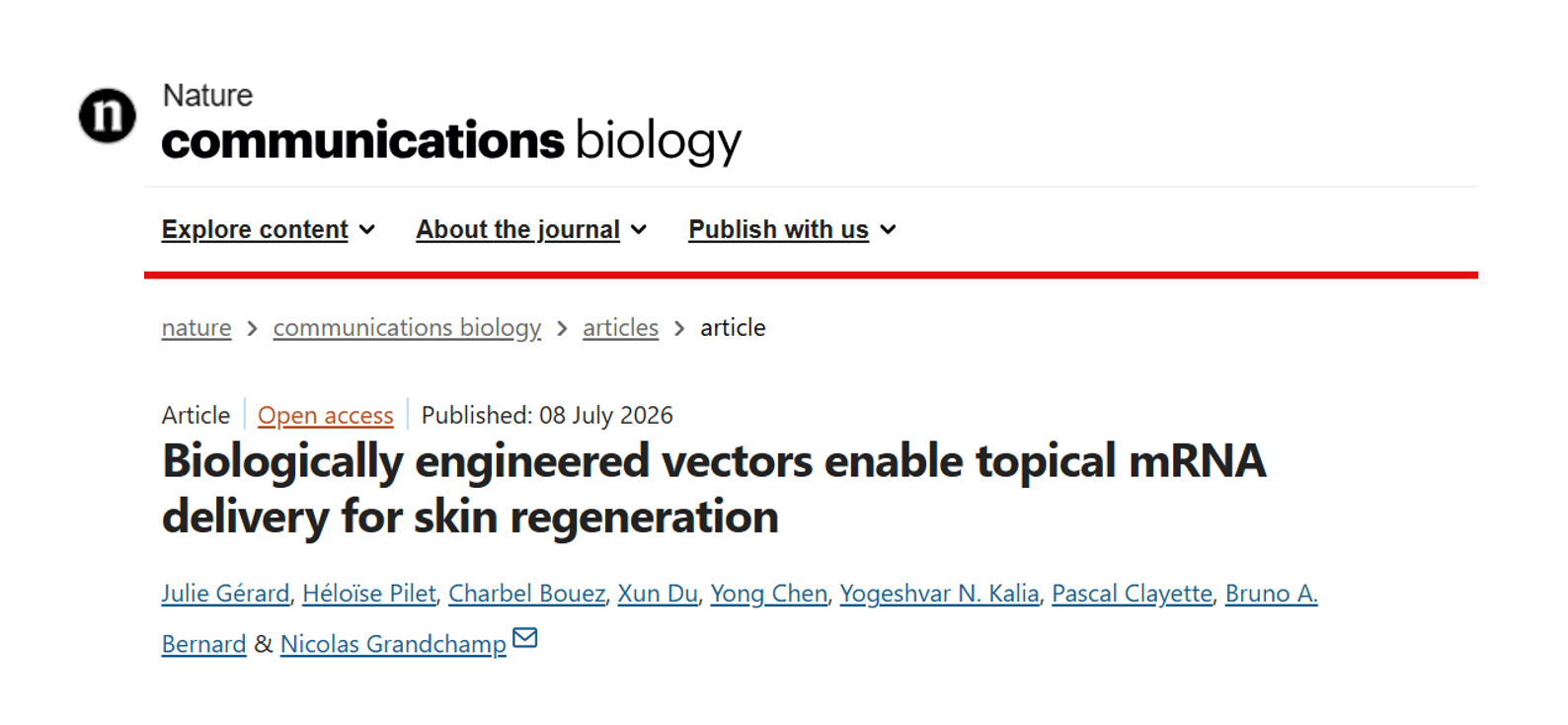
The work was published in Communications Biology in 2026:
“Biologically engineered vectors enable topical mRNA delivery for skin regeneration.”
This study established both functional proof of concept for regenerative dermatology and a peer-reviewed foundation for the RNA-BEV technology.
RNA-ONE is not limited to FGF7 or to a single dermatological indication.
The platform can be adapted around:
the RNA cargo, according to the regenerative pathway to be activated;
the formulation and administration strategy, according to the skin compartment to be reached;
the dose and expression window, according to the biological response required;
and potentially vector tropism, through engineering of the particle envelope.
This modularity provides a practical basis for developing indication-specific dermatology programs from an existing RNA-delivery platform.
Skin provides a particularly attractive environment for localized RNA programming because treatment can be applied directly to the target tissue.
Preclinical studies support a spatially controlled activity profile.
Following topical administration, RNA-ONE activity remains largely localized within the treated epidermal compartment.
Following local administration, spreading beyond the administration site is limited.
This localization is particularly relevant when the therapeutic objective is to generate a biological signal where it is needed while limiting unnecessary systemic exposure.
For regenerative dermatology, the vector therefore controls not only:
and for how long,
but also where the biological instruction acts.
RNA-ONE has moved beyond the stage of exploratory topical RNA delivery.
The platform has already been:
validated in primary and reconstructed skin models,
shown to deliver functional mRNA topically,
demonstrated to produce transient epidermal expression,
evaluated in an in vivo wound-healing model,
and published in a peer-reviewed journal.
GEG Tech can therefore engage RNA-ONE directly in partner-driven regenerative dermatology programs.
Development can start from an existing therapeutic factor, target pathway or dermatological indication and focus on adapting the RNA cargo, formulation, administration strategy and dosing profile.
The objective is to allow industrial partners to build on an existing and experimentally validated RNA-delivery platform, rather than starting from a new delivery technology at discovery stage.
| Development milestone | Status |
|---|---|
| Functional RNA delivery in keratinocytes | Demonstrated |
| Topical RNA delivery | Demonstrated |
| Reconstructed human epidermis | Demonstrated |
| Transient epidermal expression | Demonstrated |
| Functional regenerative activity in vitro | Demonstrated |
| In vivo regenerative activity | Demonstrated |
| Histological improvement in disease model | Demonstrated |
| Local biodistribution / spatial control | Characterized preclinically |
| Room-temperature stability | Demonstrated preclinically |
| Peer-reviewed publication | Published |
| Partner-specific program development | Available |
GEG Tech operates through a collaborative studio-lab model.
For regenerative dermatology programs, RNA-ONE can be integrated into industrial development around:
Identification or integration of regenerative RNA candidates.
Adaptation of RNA-ONE to the biological objective.
Optimization of administration conditions and tissue exposure.
Assessment of expression, biodistribution, biological activity and tissue regeneration.
Progression toward application-specific development with industrial partners.
Bring the biological target. We engineer the RNA delivery strategy around the tissue and therapeutic objective.
RNA-ONE development in regenerative dermatology has progressed from mechanistic studies to in vivo efficacy and peer-reviewed publication.
Scientific evidence
Communications Biology — 2026
The study demonstrated topical delivery of functional mRNA, transient expression within reconstructed human epidermis and regenerative activity of RNA-ONE-FGF7 in preclinical wound-healing models.
Read the publicationRegenerative dermatology increasingly depends on the ability to activate biological pathways locally, transiently and at the appropriate stage of tissue repair.
RNA-ONE provides an existing technological foundation for this approach.
Rather than supplying only the final biological factor, RNA delivery allows the tissue itself to transiently produce the signal required for regeneration.
Local delivery. Transient expression. Programmable regeneration.
A platform ready to be adapted to the next regenerative dermatology program.
Discuss a dermatology programExplore RNA-ONEAll application areas