Target validation
Transient or stable gain- and loss-of-function approaches can help determine whether modulation of a biological target produces the expected phenotype.
Application Areas
Vectorology as a tool to interrogate, model and perturb biology.
Vectors are not only therapeutic delivery systems.
They are also powerful experimental tools to introduce precisely defined biological perturbations into cells, tissues and organisms.
By controlling what is expressed, where it is expressed and for how long, vectorology can help researchers understand biological mechanisms, build relevant experimental models and translate biological hypotheses into drug-discovery programs.
GEG Tech applies its vector engineering capabilities across both academic biology discovery and industrial drug discovery.
Understanding biology often requires more than observing it.
A pathway may need to be activated or inhibited.
A gene may need to be removed, introduced or temporarily silenced.
A specific cell population may need to be controlled.
A biological event may need to be visualized in real time.
Or a disease mechanism may need to be recreated in a cellular or animal model.
Vectorology provides the means to turn these questions into controlled biological interventions.
Perturb. Control. Observe. Model.
Drug discovery increasingly depends on experimental models able to reproduce a defined biological mechanism with sufficient control and reproducibility.
GEG Tech works with industrial partners to design vector-based strategies that support different stages of the discovery process.
These can include:
Transient or stable gain- and loss-of-function approaches can help determine whether modulation of a biological target produces the expected phenotype.
Vector-mediated perturbations can isolate pathways, cellular functions or molecular interactions and help clarify how a candidate drug produces its biological effect.
Stable, inducible or transient genetic modifications can generate cell systems designed around a specific pharmacological question.
Genetic modifications can reproduce defined disease-associated phenotypes in cellular or animal systems.
Reporter systems, engineered pathways and genetically defined models can provide reproducible biological readouts for compound evaluation and screening.
The vector is therefore not simply a reagent.
It becomes part of the experimental model.
For academic research, the objective is often different.
The question may not yet be therapeutic.
It may simply be:
What does this gene do?
Which cells control this phenotype?
What happens if this pathway is activated only temporarily?
How does a biological system respond when a specific function is removed or introduced?
GEG Tech provides vector architectures that allow researchers to translate these questions into experimentally controlled biological perturbations.
Depending on the scientific question, the appropriate strategy may require persistent DNA expression, transient RNA expression, gene silencing, genome editing, inducible systems, cell-specific expression or real-time imaging.
This is where vectorology becomes an exploratory science platform.
Unlike therapeutic applications, discovery does not require one universal delivery modality.
The experimental objective determines the vector.
When a biological function must be maintained over time, integrating DNA vectors can establish stable expression in dividing or non-dividing cells.
When the perturbation itself should disappear, RNA-ONE or non-integrating architectures can provide temporary expression without establishing a permanently expressed transgene.
RNA interference can provide transient or sustained knockdown depending on the experimental design and vector architecture.
CRISPR and other genome-editing systems can generate knockout, knock-in or genetically defined experimental models.
Temporal control can be introduced when the timing of a biological perturbation is itself part of the experimental question.
Promoter selection and vector tropism can restrict a biological intervention to selected cellular populations.
The experimental question defines the vector architecture — not the other way around.
Genetically engineered cellular models are a central tool for both biological research and pharmaceutical discovery.
GEG Tech develops customized cellular systems ranging from straightforward stable expression to more complex genetic architectures.
Programs can include:
stable or transient expression,
gain- or loss-of-function models,
knockout and knock-in systems,
inducible expression,
reporter and selection systems,
and engineering of cells that are difficult to modify using conventional approaches.
These models can support pathway exploration, target validation, screening, mechanism-of-action studies and pharmacological evaluation.
The objective is not simply to generate a modified cell line.
It is to generate a biologically relevant experimental system designed around the scientific question.
Some biological questions require the complexity of an intact organism.
Vectorology can provide efficient routes to generate genetically defined animal models for:
gene-function studies,
disease modeling,
and preclinical research.
GEG Tech has used vector-based transgenesis and genetic engineering approaches in both small and large animal models.
Depending on the objective, models can incorporate tissue-specific promoters, inducible systems or genome-editing technologies to control where, when and how the genetic modification is expressed.
GEG Tech’s historical programs include genetically engineered mouse models as well as large-animal models, including transgenic swine. GEG Tech
RNA interference remains a powerful way to explore gene function and validate biological targets.
Vector-mediated RNAi can overcome some of the limitations of conventional transfection, particularly in difficult-to-transfect cells and in vivo models.
Depending on the vector architecture, gene inhibition can be designed to be transient or sustained, and expression can be adapted to selected cellular contexts.
GEG Tech has developed RNAi strategies using vectorized shRNA for both in vitro and in vivo applications. Its existing platform has, for example, been used to screen shRNAs targeting endogenous genes and to develop cell- and tissue-specific silencing strategies.
Some biological questions require control on a much shorter timescale.
Optogenetics combines genetic engineering with optical stimulation to activate or inhibit defined cellular populations with high temporal precision.
Vectorology is a critical part of this approach because the light-sensitive biological machinery first has to be delivered efficiently to the appropriate cells.
GEG Tech has developed vector systems carrying optogenetic effectors such as Channelrhodopsin-2 (ChR2) and Halorhodopsin (NpHR) for experimental applications in neuronal and other excitable-cell systems.
This illustrates a broader principle:
vectorology can control not only what biological function is introduced, but also how the researcher interacts with it experimentally.
Understanding delivery itself can also become part of the biological question.
In collaboration with NeoVirTech, GEG Tech integrated the ANCHOR technology into its vector systems, enabling fluorescent visualization of vector genomes in living cells.
The approach allows researchers to follow vector genomes over time and quantify them at the single-cell level.
It can be used to investigate vector entry and intracellular dynamics, optimize transduction conditions and characterize genetically modified cell populations.
ANCHOR therefore turns the vector from a delivery tool into an observable experimental object.
| Experimental objective | Vectorology capability |
|---|---|
| Stable gain of function | DNA vectorization |
| Transient gain of function | RNA / non-integrating vectorization |
| Gene knockdown | RNA interference |
| Knockout / knock-in | Genome editing |
| Temporal control | Inducible systems |
| Cell-specific perturbation | Promoter & tropism engineering |
| Functional imaging | Reporter systems |
| Cellular control | Optogenetics |
| Vector genome visualization | ANCHOR live tracking |
| Engineered cell models | Available |
| Engineered animal models | Available |
| Partner-specific discovery programs | Available now |
The same vectorology principles can operate at very different stages of biological innovation.
An academic laboratory may use a vector to determine the function of a gene.
A pharmaceutical team may use a related perturbation to validate the same pathway as a therapeutic target.
That perturbation can then be incorporated into a cellular model, an animal model or a pharmacological assay.
Vectorology can therefore connect:
biological discovery → target validation → model engineering → drug discovery.
GEG Tech works at this interface, designing vector-based experimental strategies around the biological question rather than around a predefined product.
Projects can start from very different points:
a gene whose function remains uncertain,
a candidate therapeutic target,
a pathway that needs to be perturbed,
a difficult cellular model,
an animal phenotype to reproduce,
or an assay that requires a controlled biological readout.
GEG Tech can contribute through:
Selecting the appropriate type and duration of biological perturbation.
Choosing DNA, RNA, integrating, non-integrating, silencing, editing or reporter architectures.
Generating cellular or animal systems adapted to the scientific objective.
Confirming that the engineered system produces the intended biological phenotype.
Adapting genetically defined models to target validation, mechanism-of-action studies or compound evaluation.
Bring the biological question. We engineer the experimental system around it.

Biology discovery
A genetically engineered mouse model developed to investigate mitochondrial biology and the consequences of bypassing cytochrome-c oxidase blockade.
Large-animal modeling
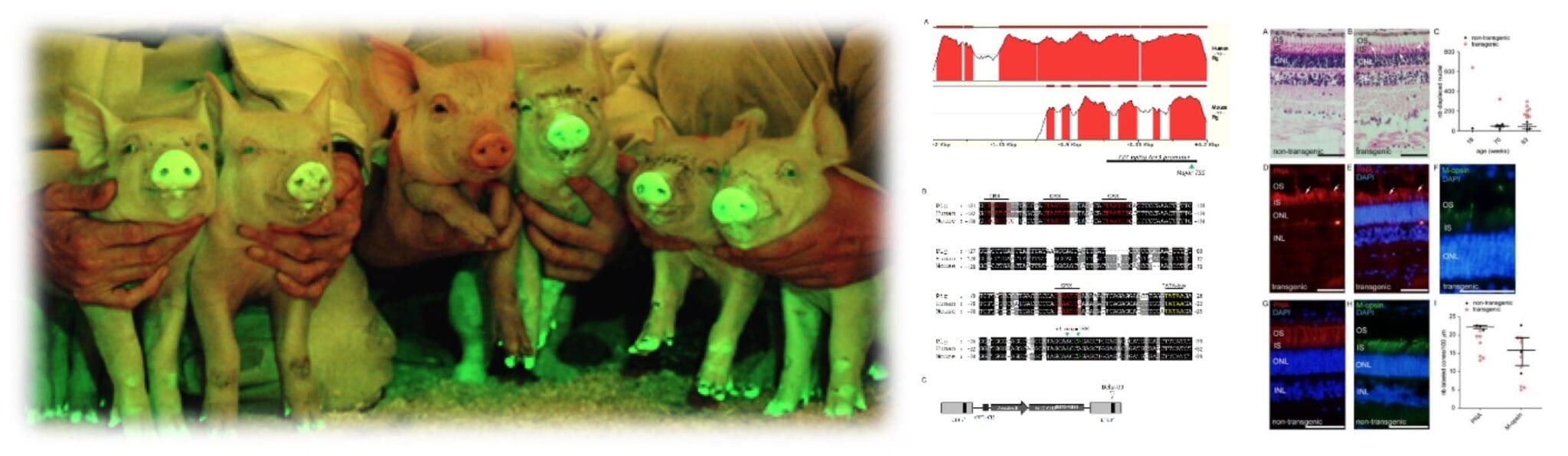
GEG Tech vectorology has been applied to the generation of large-animal models, including transgenic swine for ophthalmology research.
Technology milestone
GEG Tech and NeoVirTech combined vector engineering and ANCHOR technology to visualize and quantify vector genomes directly in living cells.

Industrial drug discovery
GEG Tech develops customized vector and model-engineering strategies with industrial partners to support target validation, biological mechanism studies and drug-discovery programs.
Discuss a Drug Discovery ProgramVectorology is often associated with gene therapy.
Its role is broader.
Every time a biological question requires a controlled genetic perturbation, delivery becomes part of the experimental design.
Stable or transient.
Activation or inhibition.
Cellular or in vivo.
Observable or inducible.
GEG Tech brings these possibilities together within a common vectorology framework.
Perturb. Control. Observe. Model.
Vectorology to understand biology — and turn biological understanding into new therapeutic opportunities.
Discuss a discovery programExplore our technologyAll application areas