Cargo
The RNA payload can encode different biological functions, from therapeutic proteins to increasingly complex genome-editing machinery.

About GEG Tech
GEG Tech is a French deeptech company specialized in vectorology and genetic engineering.
We develop engineered systems for the delivery of biological information, with a particular focus on Biologically Engineered Vectors (BEVs) and transient RNA delivery.
Our work spans precision gene therapy and genome editing, vaccination, cancer immunotherapy, regenerative medicine, skin health and biological discovery.
These applications address very different biological challenges, but they share one fundamental question:
How do we deliver the right biological instruction to the right cells, in the right place and for the appropriate duration?
This is where GEG Tech operates.
GEG Tech’s expertise in viral vector engineering provided the foundation for a broader generation of Biologically Engineered Vectors, extending beyond conventional viral vectors to both viral and non-viral architectures.
For decades, vectorology has enabled gene transfer and gene therapy. Today, RNA medicine, genome editing and cellular programming are expanding its role.
Increasingly, the objective is not necessarily to introduce a gene permanently, but to deliver a biological instruction temporarily:
Then stop.
This evolution changes the requirements placed on vectors.
The question is no longer only what can be delivered, but also to which cells, where and for how long.
For GEG Tech, vectorology is the discipline that connects molecular innovation with biological execution.
The traditional distinction between viral and non-viral vectors increasingly describes where a technology originated rather than what it has become.
Modern vector engineering can separate and redesign functions that were historically linked together: particle assembly, cargo incorporation, cell entry, intracellular delivery, reverse transcription, integration, tropism and duration of expression.
GEG Tech and collaborators therefore proposed the term Biologically Engineered Vectors — BEVs to describe an emerging class of delivery systems in which biological assembly, cellular engineering or biologically derived mechanisms are deliberately engineered to transport biological information.
BEV is not the name of a GEG Tech product.
It is a broader technological framework intended to better reflect the evolution of modern vectorology.
The terminology was introduced in a peer-reviewed Communications Biology publication in 2026.
An RNA-BEV is a Biologically Engineered Vector designed to deliver functional RNA.
RNA-BEV describes a technological class.
RNA-ONE is GEG Tech’s proprietary RNA-BEV platform.
The relationship is therefore simple:
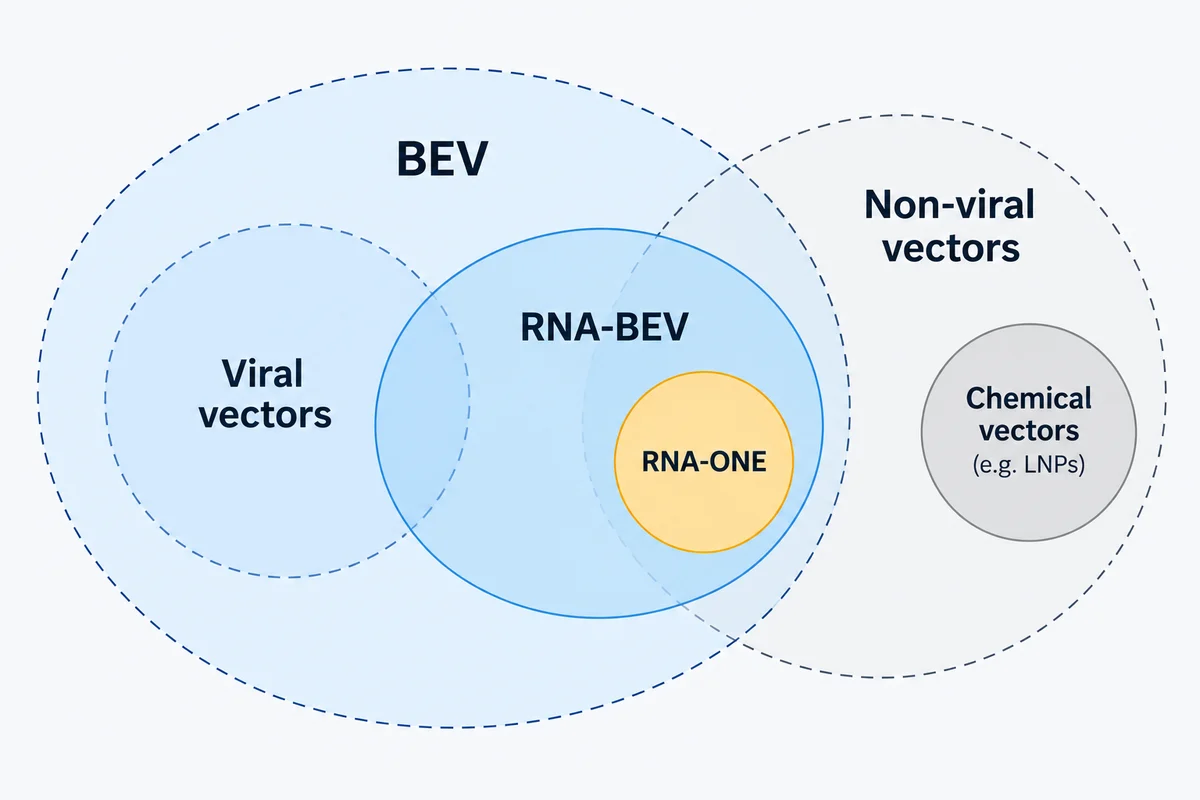
BEVRNA-BEVRNA-ONE
RNA-ONE originates from knowledge developed through lentiviral vectorology, but its biological function has been fundamentally re-engineered.
Conventional integrative lentiviral vectors follow a pathway from:
RNADNAintegrationstable expression
RNA-ONE is designed around:
RNAtransient expression
The RNA itself is the functional information delivered to the target cell.
This changes not only the duration of expression, but the role of the vector itself: from stable gene transfer to transient biological programming.
RNA-ONE has been designed around three complementary dimensions of vector engineering:
The RNA payload can encode different biological functions, from therapeutic proteins to increasingly complex genome-editing machinery.
RNA-ONE’s particle envelope can be engineered to modify cellular tropism and influence which cells interact with the vector.
Because the functional payload is RNA, expression is transient by design.
Together, these properties provide control over three fundamental questions:
CargoWhat biological information should be delivered?
TropismWhere should it act?
TimeFor how long should it remain active?
This combination of programmable cargo, engineerable tropism and transient expression makes RNA-ONE particularly relevant to the growing shift toward direct in vivo therapies.
As advanced therapies increasingly move from ex vivo cell manipulation toward direct intervention inside the body, the delivery system itself becomes an integral part of therapeutic design.
RNA-ONE illustrates how deeply vector engineering can transform a biological delivery system.
The platform retains selected biological capabilities associated with particle assembly and cellular entry while removing the requirement for conventional stable gene transfer.
In its standard RNA-delivery configuration, the RNA-ONE architecture was reviewed in 2026 by the French authority responsible for contained GMO use.
For the configuration described, particles transferring coding or non-coding RNA were considered not to be GMOs and not to generate GMOs, provided that the transferred RNA does not encode a replicative viral genome, reverse-transcriptase activity capable of generating DNA, or a genome-editing system.
The regulatory status therefore partly depends on the nature of the RNA payload.
For GEG Tech, this evolution illustrates a central principle of modern vectorology:
biological origin does not determine biological function.
A biological architecture can be deconstructed, re-engineered and repurposed around a fundamentally different delivery objective.
RNA-ONE is not simply an optimized conventional lentiviral vector.
It represents a shift:
from viral gene transfer to biologically engineered RNA delivery.
RNA-ONE is being developed as a versatile in vivo RNA-delivery platform, rather than around a single therapeutic indication.
It has generated preclinical proof-of-concept across several biologically distinct areas.
RNA-ONE has been evaluated in preclinical vaccine models targeting infectious pathogens for which satisfactory vaccines remain unavailable or insufficient.
RNA-ONE has been evaluated for transient delivery of genome-editing machinery, including preclinical work in inherited retinal disease models.
The principle is particularly relevant to editing:
the genomic correction may be permanent while the editor remains transient.
RNA-ONE has been evaluated in preclinical immuno-oncology settings, including approaches exploring transient immune programming and direct in vivo delivery.
RNA-ONE has been evaluated for topical RNA delivery and regenerative applications, including FGF7 mRNA delivery in skin and wound-healing models.
Transient vector-mediated perturbation can also be used to investigate biological functions, explore pathways and build advanced experimental models.
These programs involve different cargos, tissues, administration routes and biological endpoints.
Their common technological basis is the controlled delivery of functional RNA in vivo.
The applications change.
The vectorology question remains.
Preclinical biodistribution studies in rodents are helping characterize RNA-ONE beyond functional efficacy.
Following topical administration, RNA-ONE can penetrate the epidermal layers and drive transient expression within the epidermal compartment, as demonstrated in reconstructed human epidermis in the 2026 Communications Biology publication.
Following local injection, spreading beyond the administration site remains limited.
Following systemic administration, RNA-ONE shows a controlled biodistribution profile, with limited accumulation in major filtering organs such as the liver.
These observations complement the ability to engineer the RNA-ONE envelope to modify cellular tropism.
Together, envelope engineering and route-dependent biodistribution provide complementary ways to control where biological information acts in vivo.
Combined with programmable RNA cargo and transient expression, this gives RNA-ONE three central dimensions of vector engineering:
Cargo.Tropism.Time.
These properties are particularly relevant to direct in vivo therapies, where effective delivery increasingly requires control not only over what is delivered, but also over which cells receive it and for how long it acts.
These findings remain preclinical, and their translation to humans will require further development.
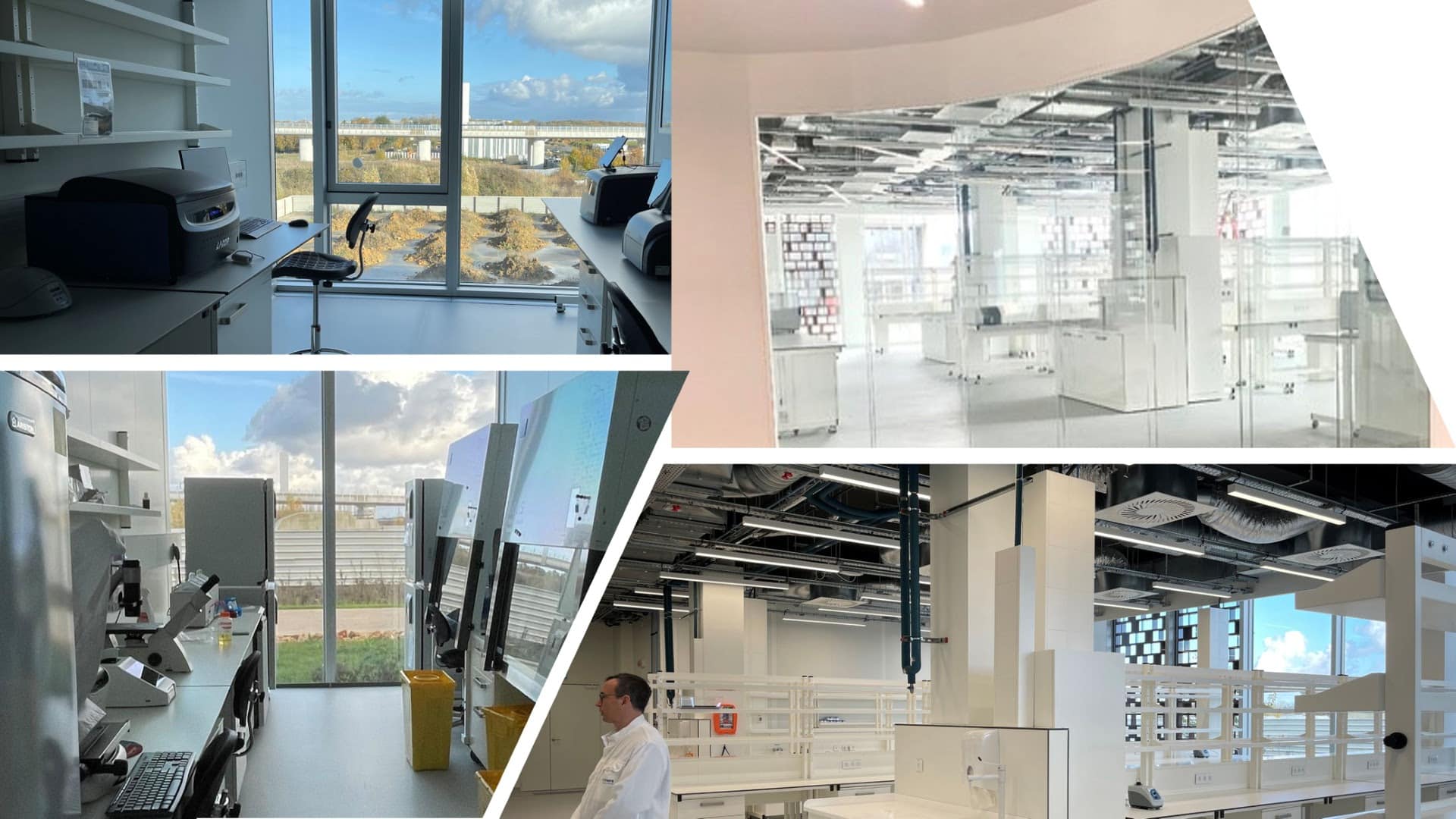
GEG Tech operates as a scientific studio-lab.
We do not aim to internalize every therapeutic field in which our vectors could be applied.
Instead, we combine our expertise in vectorology with the biological, disease and translational expertise of academic laboratories, biotechnology companies and pharmaceutical research teams.
This model allows vector design and biological application to evolve together, from early exploration and vector engineering to preclinical proof-of-concept and dedicated application programs.
Each project also contributes to the development of the platform itself.
A retinal editing experiment, a vaccine study, an immunotherapy program or a regenerative application may answer different biological questions while improving our understanding of vector behavior.
We use vectorology to modify biology — and biology to improve vectorology.
GEG Tech does not believe that one delivery technology will solve every biological problem.
AAV, lentiviral vectors, lipid nanoparticles, extracellular vesicles, virus-like particles and BEVs each offer different combinations of properties.
The relevant question is not which vector is universally “best”.
It is:
Which vector architecture best matches the biological instruction, target tissue and therapeutic objective?
Our technologies are therefore evaluated progressively through experimental studies, external collaborations and, whenever appropriate, peer-reviewed publication.
In 2026, GEG Tech and collaborators published “Biologically engineered vectors enable topical mRNA delivery for skin regeneration” in Communications Biology, providing a peer-reviewed foundation for the BEV framework and demonstrating transient biologically engineered RNA delivery in regenerative models.
RNA-ONE has also generated preclinical proof-of-concept across vaccination, precision gene therapy, cancer immunotherapy and skin health, providing increasingly diverse biological contexts in which to characterize the platform.
Our ability to write biological instructions is progressing rapidly.
RNA can encode increasingly sophisticated functions. Genome-editing technologies can generate durable changes from increasingly precise and transient interventions. Synthetic biology is expanding the range of cellular functions that can be programmed.
The next challenge is delivering these instructions into living systems.
We believe this evolution will give RNA-based delivery — whether biologically engineered or synthetic — an increasingly central role in nucleic-acid medicine.
RNA introduces a powerful degree of temporal control: the molecular instruction can be transient while its biological consequence may be either transient or durable.
A temporary RNA signal can drive short-lived protein expression, initiate an immune or regenerative response, or generate a permanent genomic modification when coupled to genome editing.
This creates a broad therapeutic space for transient programming with potentially lasting consequences.
DNA-based vectors will remain complementary and essential where the biology requires the delivery of larger genetic information or the sustained expression of an exogenous function.
The future of nucleic-acid delivery will therefore not be defined by RNA replacing DNA, but by a more precise matching of the vector to the biological objective.
RNA for transient programming with potentially durable consequences.
DNA when larger genetic information or sustained exogenous expression is required.
At the same time, advanced therapies are increasingly moving from ex vivo manipulation toward direct in vivo intervention.
This transition places new demands on vectorology.
The vector must not only carry the appropriate biological instruction. It must increasingly control which cells receive it, where it acts and for how long.
This is where technologies such as RNA-ONE become particularly relevant: combining programmable RNA cargo, engineerable tropism and transient expression within a biologically engineered delivery system.
As medicine becomes programmable, delivery becomes a defining part of therapeutic design.
Engineering vectors to understand, program and repair biology.