
Frequently asked questions
Vectorology, BEVs and RNA delivery
What is GEG Tech?
GEG Tech is a French deeptech company specialized in vectorology and genetic engineering.
The company develops engineered delivery systems for biological information, with a particular focus on Biologically Engineered Vectors (BEVs) and transient RNA delivery.
GEG Tech applies this expertise to genome editing, vaccination, cancer immunotherapy, regenerative medicine, skin health and biological discovery through collaborations with academic and industrial partners.
What is vectorology?
Vectorology is the science and engineering of systems used to deliver biological information into cells.
Historically, the field has largely been structured around a distinction between viral and non-viral vectors.
Today, engineered extracellular vesicles, virus-like particles and deeply re-engineered biological particles increasingly blur this distinction.
Modern vectorology therefore needs to consider not only where a vector originates, but also how it is engineered, what information it carries, which cells it reaches and for how long it acts.
Why is vectorology becoming increasingly important?
Modern biological medicines can encode increasingly sophisticated instructions.
- mRNAs can produce therapeutic proteins.
- Genome editors can rewrite DNA.
- Synthetic biology can create new cellular functions.
But none of these technologies can act unless their molecular instructions reach the appropriate cells.
Vectorology therefore connects molecular innovation with biological execution.
As medicine becomes more programmable, delivery becomes a defining part of therapeutic design.
What are Biologically Engineered Vectors?
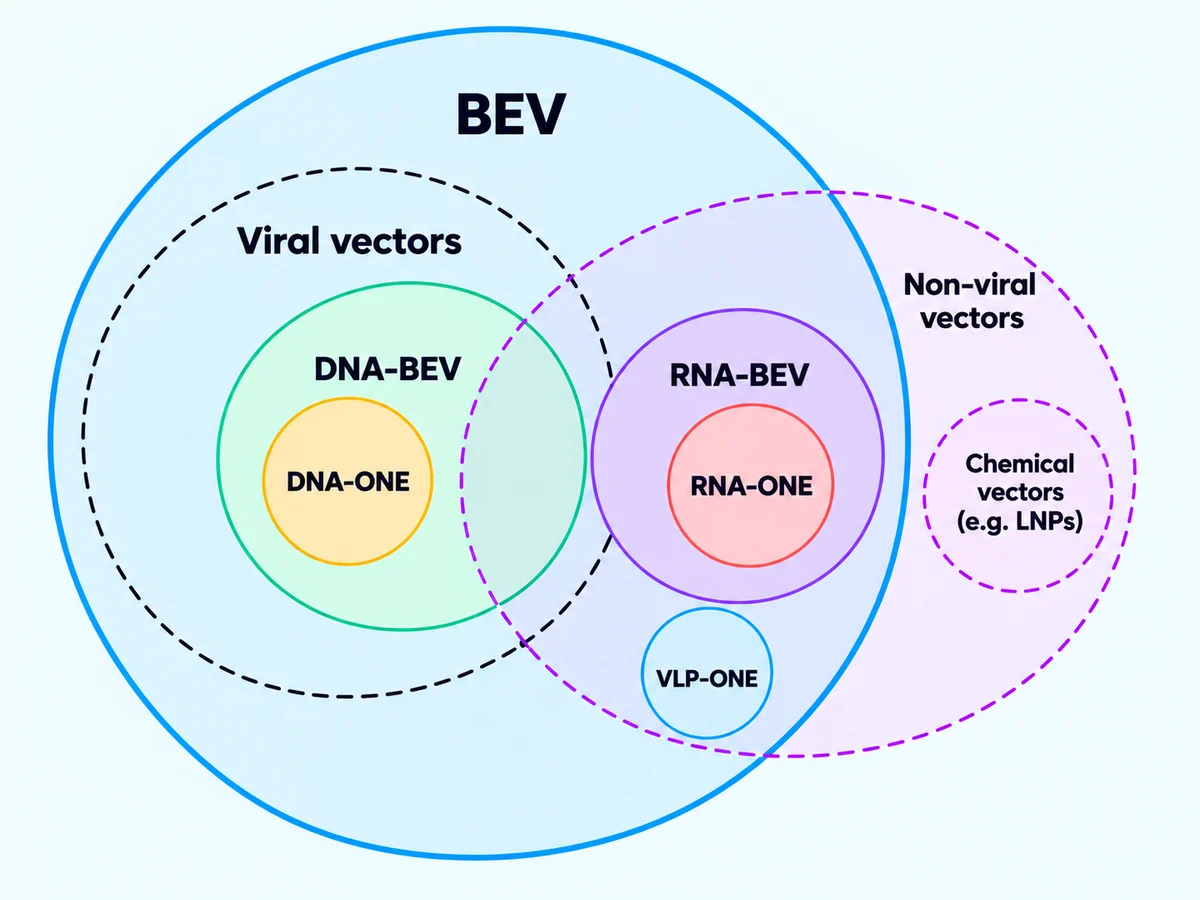
Biologically Engineered Vectors — BEVs — are an emerging class of delivery systems in which biological assembly, cellular engineering or biologically derived mechanisms are deliberately engineered to transport biological information.
GEG Tech and collaborators introduced the BEV terminology to provide a framework that goes beyond the traditional viral / non-viral classification.
BEV is therefore not the name of a GEG Tech product.
It is a broader proposed classification for a new generation of biologically engineered delivery systems.
Why propose a new BEV classification?
The traditional viral / non-viral distinction no longer fully captures the diversity of emerging vector technologies. The BEV framework reflects this more complex and evolving landscape.
Modern vector engineering can separate biological functions that were historically linked together:
- particle assembly,
- cargo incorporation,
- cell entry,
- intracellular delivery,
- reverse transcription,
- integration,
- and duration of expression.
These functions can then be recombined or removed according to the biological objective.
The BEV framework focuses on this engineering logic:
using biology itself as part of the delivery system, without assuming that the final vector retains the biological properties of the system from which it originated.
Is BEV an established scientific classification?
Not yet.
BEV is an emerging classification proposed by GEG Tech and collaborators to describe a developing technological space.
The terminology was introduced in a peer-reviewed Communications Biology publication in 2026.
Its broader adoption will depend on whether researchers find the classification useful for describing emerging biological delivery technologies.
What is an RNA-BEV?
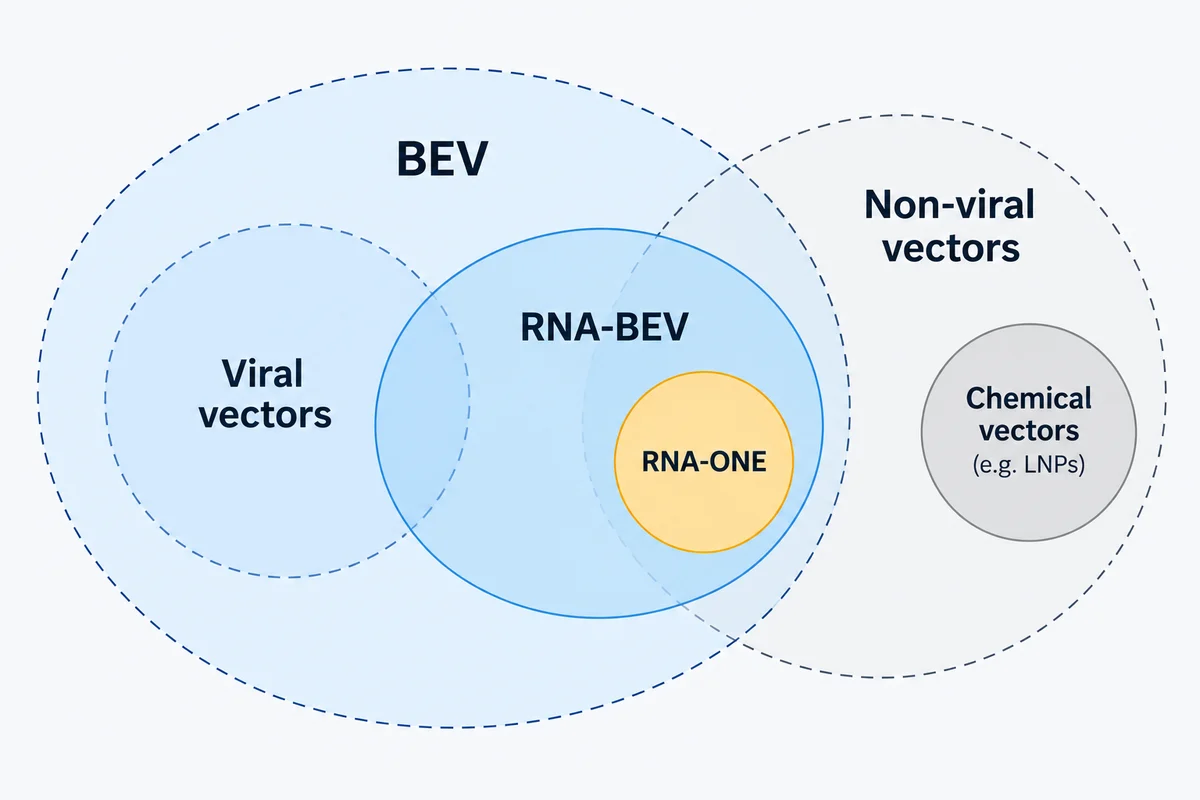
An RNA-BEV is a Biologically Engineered Vector designed to deliver functional RNA.
RNA-BEV therefore describes a class of vectors, not a specific GEG Tech technology.
Different platforms developed by different organizations could belong to this class.
For example, engineered extracellular vesicles specifically designed to package and deliver functional RNA may fit within the RNA-BEV framework.
What is RNA-ONE?
RNA-ONE is GEG Tech's proprietary RNA-BEV technology.
It is a biologically assembled vector engineered for transient delivery of functional RNA.
RNA-ONE therefore represents one specific technological implementation within the broader RNA-BEV category.
The relationship is simple:
BEVRNA-BEVRNA-ONE
- BEV is the broader classification.
- RNA-BEV is the RNA-delivery subclass.
- RNA-ONE is the proprietary GEG Tech technology.
Is RNA-ONE a conventional lentiviral vector?
No.
RNA-ONE originates from knowledge developed through lentiviral vectorology, but its biological function has been fundamentally re-engineered.
Conventional integrative lentiviral vectors use an RNA genome as an intermediate before generating DNA and establishing stable genetic expression.
RNA-ONE is designed so that RNA itself is the functional payload.
The conventional sequence:
RNADNAintegrationstable expression
is replaced by:
RNAtransient expression
RNA-ONE therefore uses selected biological properties inherited from particle vectorology while removing the requirement for conventional stable gene transfer.
Is RNA-ONE considered a GMO?
In its standard RNA-delivery configuration, RNA-ONE was considered not to be a GMO and not to generate a GMO by the French authority responsible for contained GMO use following review of the architecture in 2026.
This conclusion applies to particles transferring coding or non-coding RNA when the transferred RNA does not encode:
- a replicative viral genome,
- reverse-transcriptase activity capable of converting the RNA into DNA,
- or a genome-editing system.
The regulatory status therefore depends partly on the nature of the RNA payload.
Why is RNA-ONE being considered non-GMO significant?
Because RNA-ONE originates from an architecture developed through lentiviral vectorology.
Conventional lentiviral vectors belong historically to the world of genetically modified viral vectors and stable genetic transfer.
RNA-ONE demonstrates that these biological mechanisms can be deconstructed and re-engineered deeply enough to create a delivery system with a fundamentally different biological function and regulatory identity.
It remains biologically assembled.
But it is no longer operating as a conventional genetically modified viral vector.
This transition illustrates the central idea behind the BEV framework:
biological origin does not determine biological function.
Does this represent a technological break from conventional viral vectorology?
Yes, in functional terms.
RNA-ONE does not simply optimize a classical lentiviral vector.
Its engineering changes the role of the particle itself.
The objective is no longer to use a viral architecture to establish persistent genetic information.
It is to use selected biological mechanisms of assembly and cellular delivery to transport a temporary RNA instruction.
This represents a shift:
from viral gene transfer to biologically engineered RNA delivery.
For GEG Tech, this is one illustration of how modern vectorology can evolve beyond the historical viral / non-viral framework.
Does RNA-ONE integrate into the genome?
RNA-ONE is designed for transient RNA delivery and does not require genomic integration to express its payload.
The RNA is used directly as biological information.
If RNA-ONE is used to deliver a genome-editing system, however, the editor may itself generate a permanent genomic modification.
This creates an important distinction:
transient delivery can produce a durable biological effect.
What does “permanent edit, transient editor” mean?
A genome editor can create a permanent genomic change even if the editing machinery is expressed only temporarily.
The desired edit may therefore remain indefinitely while exposure to the editor itself remains limited in time.
This is one reason transient RNA delivery is particularly relevant to genome editing.
Why can transient RNA delivery be useful?
Many biological interventions do not require permanent expression.
- A genome editor may only need to remain active long enough to generate an edit.
- A regenerative factor may only be required during a defined phase of tissue repair.
- An immune signal may only need to persist long enough to initiate a response.
Transient delivery allows the duration of the molecular intervention to be separated from the duration of its biological effect.
Has RNA-ONE been validated across different preclinical applications?
Yes.
RNA-ONE has generated preclinical proof-of-concept across several biologically distinct areas, supporting its development as a versatile RNA-BEV platform rather than an indication-specific vector.
These include:
Vaccination against infectious pathogens
RNA-ONE has been evaluated in preclinical vaccine models targeting pathogens for which satisfactory vaccines remain unavailable or insufficient.
Precision gene therapy and genome editing
RNA-ONE has been evaluated for transient delivery of genome-editing machinery, including preclinical work in inherited retinal disease models.
Cancer immunotherapy
RNA-ONE has been evaluated in preclinical immuno-oncology settings, including approaches aimed at delivering transient biological instructions to immune cells in vivo.
Skin health and regenerative medicine
RNA-ONE has been evaluated for topical RNA delivery and regenerative applications, including FGF7 mRNA delivery in skin and wound-healing models.
These programs use different cargos, tissues and biological objectives.
Their common technological basis is the ability to deliver functional RNA transiently in vivo.
Why is validation across different preclinical models important?
A delivery technology can perform well in one biological context without necessarily translating to another.
Vaccination, retinal gene editing, cancer immunotherapy and skin regeneration involve very different tissues, routes of administration, cell populations and biological endpoints.
Evaluating RNA-ONE across these settings therefore provides information not only about individual applications, but also about the versatility and limits of the underlying vector platform.
For GEG Tech, these programs are both application studies and vectorology experiments.
The applications change. The vectorology question remains.
Can RNA-ONE deliver genome editors?
GEG Tech is exploring RNA-ONE and related RNA-vector architectures for the delivery of complex genome-editing systems, including base-editing and prime-editing approaches.
In collaboration with researchers at the University of California, Irvine, GEG Tech has publicly reported preclinical work using RNA-vector delivery of base-editing machinery in an inherited retinal disease model.
When the payload itself performs genome editing, the regulatory classification must be considered separately from the standard non-editing RNA-ONE configuration.
Why is genome editing a vectorology challenge?
Modern genome editors can be large and molecularly complex.
Their performance depends not only on editing chemistry but also on whether sufficient amounts of editing machinery can reach the correct cells and intracellular compartment.
As editors become more sophisticated, delivery becomes an increasingly important part of genome-editing technology.
Has RNA-ONE been evaluated in vivo?
Yes.
RNA-ONE has been evaluated across multiple preclinical in vivo settings, including vaccination, precision gene therapy and genome editing, cancer immunotherapy, and skin health and regenerative medicine.
Biodistribution studies have also provided initial insights into the in vivo behavior of the platform.
Following topical administration, RNA-ONE penetrates through the epidermal layers and drives transient expression within the epidermis. This localized epidermal delivery was demonstrated in the 2026 Communications Biology study, which reported functional mRNA expression throughout reconstructed human epidermis after topical administration.
Following local administration, RNA-ONE shows limited spreading beyond the injection site, supporting spatially restricted biological activity.
Following systemic administration, RNA-ONE displays a controlled biodistribution profile, with limited accumulation in major filtering organs such as the liver.
These findings are particularly relevant for a platform intended for transient in vivo biological programming: they suggest that effective biological activity can be achieved without necessarily causing extensive systemic distribution or pronounced accumulation in filtering organs.
Together with proof-of-concept studies across distinct biological settings, these data help characterize RNA-ONE not only in terms of functional efficacy, but also in terms of its biodistribution profile and spatial control.
Has RNA-ONE been published in a peer-reviewed journal?
Yes.
In 2026, Communications Biology published:
“Biologically engineered vectors enable topical mRNA delivery for skin regeneration.”
The study demonstrated biologically engineered RNA delivery and introduced the broader BEV framework in a peer-reviewed publication.
How is RNA-ONE different from lipid nanoparticles?
RNA-ONE and lipid nanoparticles use fundamentally different assembly principles.
LNPs are primarily produced through synthetic formulation of lipids and nucleic acids.
RNA-ONE is a biologically assembled RNA-BEV generated through engineered cellular systems.
These different architectures may produce different properties in terms of cellular interaction, payload handling, expression kinetics, biodistribution and stability.
Neither technology should be considered universally superior.
The relevant question is:
which delivery architecture best matches the biological problem?
Are BEVs viral or non-viral?
The BEV framework is intended precisely to move beyond this binary distinction.
Some BEVs may use biological mechanisms originally discovered through virology.
Others may derive from extracellular vesicles or other cellular systems.
Their defining characteristic is not simply their historical origin, but the fact that biological mechanisms are deliberately engineered to create a delivery function.
RNA-ONE illustrates this particularly well: its engineering heritage is lentiviral, while its final function is transient RNA delivery rather than conventional viral gene transfer.
Are engineered exosomes or extracellular vesicles RNA-BEVs?
They can be.
Engineered exosomes or extracellular vesicles specifically designed to package and deliver functional RNA can fit within the RNA-BEV framework.
Naturally occurring extracellular vesicles carrying endogenous RNA would not automatically be considered BEVs.
The defining element is engineering for a delivery function.
Where do DNA-ONE and VLP-ONE fit?
DNA-ONE, RNA-ONE and VLP-ONE are proprietary GEG Tech vector technologies addressing different delivery requirements.
- RNA-ONE is GEG Tech's main RNA-BEV technology for transient RNA delivery and in vivo biological programming.
- DNA-ONE addresses applications requiring durable genetic expression.
- VLP-ONE explores transient delivery of biological functions through biologically assembled particles.
Together, they form a broader vectorology toolbox rather than three interchangeable platforms.
What applications is RNA-ONE being explored for?
RNA-ONE is being explored across applications in which transient delivery of biological information may provide an advantage:
- Precision gene therapy & genome editing
- Vaccination
- Cancer immunotherapy
- Regenerative medicine & skin health
- Biological discovery & modeling
These applications address very different biological problems.
Their common vectorology challenge is:
delivering the right biological instruction to the right cells for the appropriate duration.
Why does GEG Tech work across different therapeutic areas?
GEG Tech is primarily a vectorology company, not a disease-focused biotechnology company.
Retinal gene editing, infectious disease vaccination, cancer immunotherapy and skin regeneration are very different biological applications.
What connects them is the delivery problem.
Working across these areas allows GEG Tech to test the same vectorology principles across different cargos, tissues, administration routes and biological environments.
This diversity is therefore not peripheral to the development of RNA-ONE.
It is part of how the platform is characterized and improved.
Does GEG Tech consider RNA-ONE a replacement for LNPs, AAV or lentiviral vectors?
No.
Different vector technologies address different biological requirements.
GEG Tech views RNA-ONE and the broader BEV framework as additions to the expanding vectorology toolbox.
The appropriate technology depends on the payload, target tissue, administration route, required duration of expression and therapeutic objective.
What is programmable medicine?
Programmable medicine describes approaches in which biological functions are modified using designed molecular instructions.
These instructions can include RNA, genome editors, synthetic receptors and other engineered biological systems.
As our ability to design these instructions improves, our ability to deliver them becomes increasingly important.
What is the future of vectorology?
Vectorology is expanding beyond its historical association with stable gene transfer.
Future vectors will increasingly need to deliver complex biological instructions with control over:
- payload,
- tissue,
- cell,
- and time.
RNA medicine, genome editing and cellular programming are accelerating this transition.
GEG Tech describes this evolution as a shift:
from gene transfer to programmable medicine.
What is GEG Tech's role in this evolution?
GEG Tech develops vector technologies while contributing to a broader way of thinking about emerging delivery systems.
Through the BEV framework, GEG Tech proposes a classification intended to better reflect the evolution of modern vectorology.
Through RNA-ONE, it demonstrates how a biological architecture historically associated with viral gene transfer can be profoundly re-engineered into a transient RNA-delivery system that, in its standard configuration, is not considered a GMO.
Its validation across preclinical models of infectious disease vaccination, precision gene therapy, cancer immunotherapy and skin health further illustrates that RNA-ONE is being developed as a versatile vectorology platform rather than around a single therapeutic indication.
The broader objective is:
engineering vectors to understand, program and repair biology.